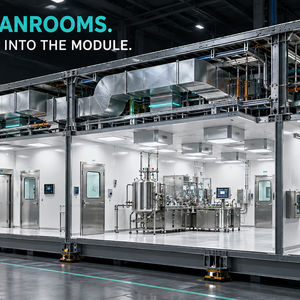



In modular pharma projects, the costliest risks often appear after the module reaches the site. A missed utility interface, an unverified control sequence, an access limitation, or a pressure cascade issue can delay commissioning and affect GMP readiness.
In conventional project delivery, many of these issues appear during site commissioning, when access is limited, timelines are compressed, and multiple contractors are working in parallel. In modular pharma projects, Factory Acceptance Testing in Modular Pharma Projects, shifts this risk forward. It allows critical systems to be checked in a controlled manufacturing environment before shipment and installation.
For pharmaceutical manufacturers, biotechnology companies, CDMOs, vaccine manufacturers, and API producers, FAT is not only a testing activity. It is a project risk-reduction tool. When planned correctly, FAT helps verify whether the modular pharmaceutical facility is aligned with user requirements, GMP intent, design specifications, and operational expectations before it reaches the site.
Why FAT Matters in Modular Pharma Facilities
A modular pharmaceutical facility is not simply a prefabricated structure. It is an integrated manufacturing environment that may include cleanrooms, HVAC systems, HEPA filtration, pressure cascades, process utilities, electrical systems, automation, EMS, BMS, and process equipment. The value of modular execution lies in bringing many of these elements together off-site, under controlled conditions.
This is where Design & Engineering plays a critical role. FAT becomes effective only when the project has a clear design basis, defined user requirements, approved drawings, utility loads, equipment layouts, and operating philosophy. Without this foundation, FAT becomes a checklist exercise. With proper engineering, it becomes a structured verification process.
In modular projects, the facility is assembled and tested before shipment. This makes it possible to identify design gaps, interface issues, equipment access concerns, utility mismatches, and control-sequence errors earlier in the project lifecycle. Correcting these issues at the module construction facility is usually more practical than resolving them after delivery, placement, and site hook-up.
FAT as a Risk-Control Step Before Shipment
Factory Acceptance Testing reduces risk by confirming that the module or equipment package has been built according to approved specifications. It helps project teams verify whether the delivered system matches the URS, design documents, P&IDs, equipment specifications, layout drawings, utility requirements, and automation logic.
For a modular manufacturing facility, this may include checks related to equipment installation, cleanroom finishes, utility routing, access panels, instrumentation, alarm logic, control panels, room zoning, pressure cascade logic, and hook-up readiness. The objective is not to complete final qualification at the factory. The objective is to reduce uncertainty before the module is transported.
This is especially important because modular pharma projects involve multiple interfaces. A process skid may depend on clean utilities. The cleanroom may depend on HVAC balancing. HVAC performance may depend on ducting, filters, sensors, dampers, and controls. Automation may depend on field instruments, alarms, interlocks, and communication with BMS or EMS.
Through Off-site Modular Construction, many of these systems can be brought together before site work reaches its most critical stage. FAT allows project teams to verify whether these systems are coordinated, accessible, and ready for shipment.

Reducing Design and Engineering Risk
One of the most important benefits of FAT is its ability to reveal design and coordination issues before they become site-level delays. Even with detailed engineering, modular projects can face practical challenges once equipment, utilities, cleanroom panels, HVAC ducts, and controls come together in the same physical space.
FAT helps confirm whether equipment is positioned correctly, whether maintenance access is available, whether instruments are reachable, whether utility routes are practical, and whether the module can support the intended operating and cleaning requirements. These are not minor details in pharmaceutical manufacturing. They directly affect GMP readiness, operational efficiency, and long-term maintainability.
For example, a pressure sensor may be technically specified but poorly located. A utility connection may be correctly sized but difficult to access after installation. A control panel may be functional but positioned in a way that complicates operation. FAT gives the project team an opportunity to identify and resolve these issues while the module is still in a controlled workshop environment.
This reinforces the importance of Pharmaceutical Facility Design as an early-stage risk management activity. A well-designed facility makes FAT more meaningful, and a well-executed FAT validates the practical readiness of that design.
Managing GMP and Cleanroom Risks
In GMP manufacturing facilities, facility performance is closely linked to contamination control, personnel flow, material flow, environmental control, and utility reliability. FAT helps project teams review whether the modular cleanroom and its supporting systems are aligned with the intended GMP strategy.
For modular cleanrooms, this may involve checking room finishes, panel joints, door interlocks, return air paths, pressure cascade logic, HVAC integration, HEPA filter installation readiness, EMS points, BMS connections, and alarm conditions. While final cleanroom qualification must be completed after installation, pre-shipment checks help reduce the risk of discovering major gaps during commissioning.
FAT also supports better documentation discipline. When observations, deviations, corrective actions, and acceptance criteria are documented before shipment, the project team has clearer evidence of what was verified at the factory and what must be reconfirmed at the site.
This is where Validation & FAT becomes an important part of integrated project delivery. FAT should be connected with later qualification, commissioning, and validation support. It should not be treated as a separate event disconnected from site readiness.
What Dual FAT Means in MMF Projects
For modular pharma projects, a dual FAT approach can further reduce risk. Dual FAT is not a separate regulatory term, but it is a practical engineering approach that fits modular execution well.
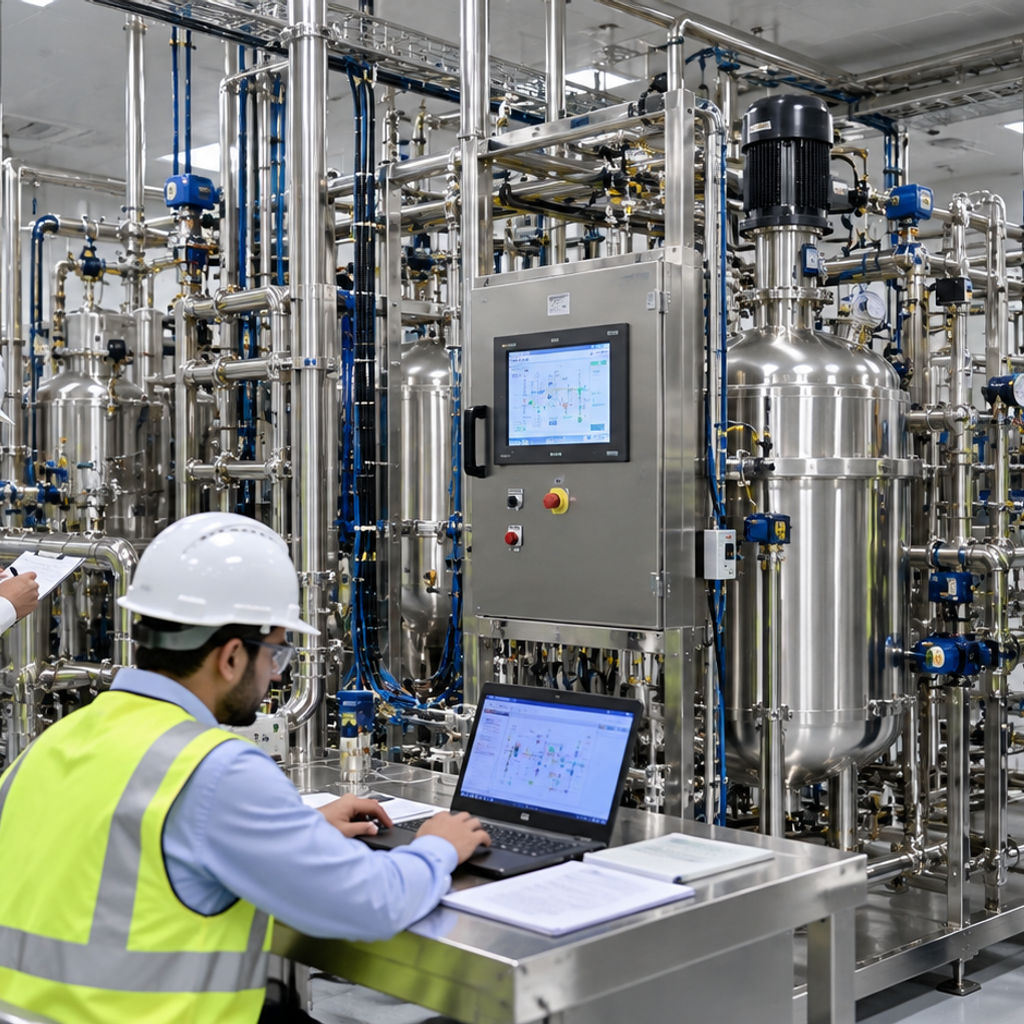
The first FAT is typically performed at the OEM or vendor level. This may apply to critical process equipment, clean utility skids, HVAC packages, automation panels, or other engineered systems. At this stage, the focus is on verifying whether the individual package performs according to its specification.
The second FAT is performed after these systems are integrated into the modular facility. This is where the focus shifts from equipment readiness to facility readiness. The question is no longer only whether a skid works. The question is whether the skid, cleanroom, utilities, HVAC, automation, and module interfaces work together as an integrated pharmaceutical manufacturing environment.
For MMF projects, this dual FAT approach is highly relevant because the facility is engineered, constructed, assembled, and checked off-site before transportation. It allows critical systems to be verified first as independent packages and then again as part of the modular facility.
This supports a clearer transition from Manufacturing to Factory Acceptance Testing, and then from FAT to Installation & Hook-up at the project site.
FAT Does Not Replace SAT, Commissioning, or Validation
FAT reduces risk, but it does not eliminate the need for Site Acceptance Testing, commissioning, or validation. This distinction is important for pharmaceutical decision-makers.
Some checks can be meaningfully completed before shipment. Others must be repeated or confirmed after transportation, unloading, placement, inter-modular connections, utility hook-up, and final site conditions. For example, a control sequence may be verified during FAT, but site power, final utility connections, pressure balancing, airflow verification, and cleanroom qualification must be confirmed after installation.
A strong FAT strategy clearly defines what is accepted at the factory, what is carried forward to site testing, and what must be confirmed during commissioning and validation. This prevents overclaiming and helps maintain compliance integrity.
Through On-Site Installation, the modular facility moves from factory-tested readiness to site-specific readiness. Placement, inter-modular connections, hook-up, commissioning, and validation support are essential to confirm that the module performs as intended in its final operating environment.
What a Strong Modular FAT Protocol Should Include
A FAT protocol for modular pharma projects should be built around risk, not only around inspection. It should reflect the URS, approved drawings, design specifications, GMP requirements, equipment data, automation logic, and operating philosophy.
A strong protocol may include verification of construction completion, equipment installation, utility routing, instrument tagging, access for operation and maintenance, automation sequences, alarms, interlocks, cleanroom finishes, HVAC integration, pressure cascade logic, EMS/BMS points, and hook-up readiness.
It should also clearly identify acceptance criteria. This helps avoid subjective decisions during FAT. Each test should define what is being verified, how it will be checked, what documentation is required, and what action is needed if the result is not acceptable.
For modular projects, the FAT protocol should also define what may be affected by transportation. Any function that could change during shipment, lifting, placement, or site reconnection should be reconfirmed during SAT, commissioning, or validation.
How FAT Supports Faster Project Delivery
One of the reasons pharmaceutical companies consider modular pharma facilities is faster project delivery. However, speed is useful only when it is supported by control. FAT helps protect the schedule by reducing late-stage rework and improving visibility before shipment.
When issues are identified during FAT, they can be corrected while the module is still accessible and before the project depends on site availability. This reduces the likelihood of delays during installation and commissioning. It also improves coordination between engineering teams, vendors, validation teams, and site project managers.
For facility owners and investors, FAT improves confidence. It provides a structured view of project readiness before the facility leaves the factory. For plant heads and operations leaders, it helps confirm that the facility has been reviewed from an operational perspective before arriving at site.
This makes FAT a practical bridge between Off-site Modular Construction and Validation & Commissioning.
Why Choose Modular Mobile Facility (MMF)?
Modular Mobile Facility supports pharmaceutical companies with turnkey modular solutions designed for GMP compliance, faster project delivery, and scalable pharmaceutical infrastructure. MMF integrates Design & Engineering, Off-site Modular Construction, Factory Acceptance Testing, Transportation, Installation & Hook-up, Validation Support, and Commissioning into a connected project delivery model.
Because MMF manages modular facility delivery from design and engineering to FAT, transportation, installation, hook-up, validation support, and commissioning, FAT is not treated as a separate inspection event. It becomes part of the complete project-readiness strategy.
For modular pharma projects, this integrated approach matters. FAT is most effective when it is planned from the beginning, aligned with design intent, connected with site installation, and supported through commissioning and validation. MMF’s approach helps reduce uncertainty by verifying key systems in a controlled environment before shipment and supporting the facility through final site readiness.
For pharmaceutical manufacturers, biotech companies, CDMOs, vaccine producers, and API manufacturers, MMF provides modular pharmaceutical facilities engineered around compliance, integration, and practical execution.
Frequently Asked Questions
1. What is FAT in a modular pharma project?
Factory Acceptance Testing is a pre-shipment verification process carried out before a modular facility, equipment package, or integrated system is transported to the site. In modular pharma projects, FAT helps confirm that the facility or system is built according to approved specifications, user requirements, and GMP design intent. It reduces the risk of discovering major issues during installation, commissioning, or validation.
2. Why is FAT important for modular pharmaceutical facilities?
FAT is important because modular pharmaceutical facilities combine cleanrooms, HVAC, utilities, equipment, controls, and automation within a factory-built environment. Testing these systems before shipment helps identify design gaps, interface issues, access concerns, and control-sequence problems early. This reduces site rework, protects the project schedule, and supports smoother commissioning.
3. What is dual FAT in modular pharma projects?
Dual FAT refers to a practical two-stage testing approach. The first FAT is performed at the OEM or vendor level for critical equipment or utility packages. The second FAT is performed after those systems are integrated into the modular facility. This helps verify both individual equipment readiness and overall facility integration before shipment.
4. Does FAT replace SAT in pharmaceutical projects?
No, FAT does not replace Site Acceptance Testing. FAT verifies systems before shipment, while SAT confirms performance after delivery, placement, hook-up, and site installation. In modular projects, some checks completed during FAT may remain valid, but functions affected by transportation, lifting, reconnection, or final site conditions must be reconfirmed onsite.
5. What should be checked during FAT for a GMP modular facility?
A FAT protocol for a GMP modular facility may include checks for construction completion, equipment installation, cleanroom finishes, utility routing, HVAC integration, pressure cascade logic, instrumentation, alarms, interlocks, EMS/BMS points, access for operation and maintenance, and hook-up readiness. The protocol should be based on URS, design documents, and risk assessment.
6. How does FAT reduce commissioning risk?
FAT reduces commissioning risk by identifying and resolving issues before the module reaches the site. Since systems are more accessible at the factory, corrections can be made earlier and with less disruption. This reduces late-stage troubleshooting, improves documentation readiness, and allows commissioning teams to focus on site-specific verification rather than unresolved factory issues.
7. Is FAT required for every modular pharma facility?
FAT is strongly recommended for modular pharma facilities, especially when the project includes complex equipment, cleanrooms, HVAC systems, process utilities, automation, or GMP-critical interfaces. The exact FAT scope depends on the project risk profile, system complexity, regulatory expectations, and agreed qualification strategy.
8. How does MMF support FAT in modular pharma projects?
MMF supports FAT as part of its integrated modular project delivery model. The process connects design, off-site modular construction, equipment integration, factory acceptance testing, transportation, installation, hook-up, validation support, and commissioning. This helps pharmaceutical companies reduce technical uncertainty before shipment and move toward site readiness with greater control.